

Just a few weeks ago the UC Berkeley School of Law announced a new set of policies regulating AI use for its students. While the full document offered some flexibility for professors who were more open to AI in their classes, the default policy for the school was vanishingly close to an outright ban:
The use of AI is prohibited for aid in conceptualizing, outlining, drafting, revising, translating, or editing any work submitted for credit. AI use is prohibited for any use for any purpose in any exam situation. Students may not upload course materials—including assignments, readings, slides, class recordings, or other class content—into generative AI systems. AI can be used for research on papers ONLY for the limited purpose of identifying sources, such as cases, statutes, or secondary sources. Students are responsible for the accuracy of their research and all other aspects of their submitted work. Citations to sources that do not exist will raise a presumption of prohibited AI use.
I suspect we are going to see an increasingly wide divergence in the coming months in the way that academic institutions integrate AI into the classroom, with many institutions following the default-ban approach taken here by Berkeley Law, while others embrace the new AI platforms (or at least some of them.) One example from the other end of the spectrum: the Harvard Law professor Larry Lessig made NotebookLM a foundational part of his constitutional law class this past semester, by creating 110 notebooks for each legal case that was covered in the syllabus. Students would then add other sources (the oral argument, newspaper reports) to deepen their understanding of how each decision was rendered. Even my old high school—which I had happened to visit for my fortieth reunion a few weeks before the Berkeley announcement—has adopted an approach that offers their teenage students significantly more agency over their AI use than Berkeley gives to its adult aspiring lawyers. Instead of a default ban, the school has introduced a tripartite system that teachers can adopt in their classes or for specific assignments, color coded along the lines of traffic signals: green means you are free to use AI in every step of the process; yellow limits you to conceptual feedback and editing suggestions; red means no AI altogether.
Let me say at the outset that I am not trying to disparage Berkeley’s policy here. It’s a complicated moment. I know the Berkeley faculty are genuinely trying to figure out an approach that minimizes learning loss and embeds solid thinking habits for their students. It undoubtedly makes sense to restrict the use of AI in assessment settings, like a final exam. And if you read the full statement announcing the policies, it’s clear that the school isn’t rejecting the utility of AI outright. It opens with these lines:
Future lawyers may need to use artificial intelligence (“AI”) fluently. But the current state of the technology requires that AI use be coupled with the cognitive skills necessary to strategically deploy the technology, to critically assess its work product, and to uphold ethical obligations to clients and to the legal system. In short, thinking remains the sine qua non of good lawyering (and of a quality legal education). This policy seeks to ensure that our courses focus on requisite cognitive skills by default.
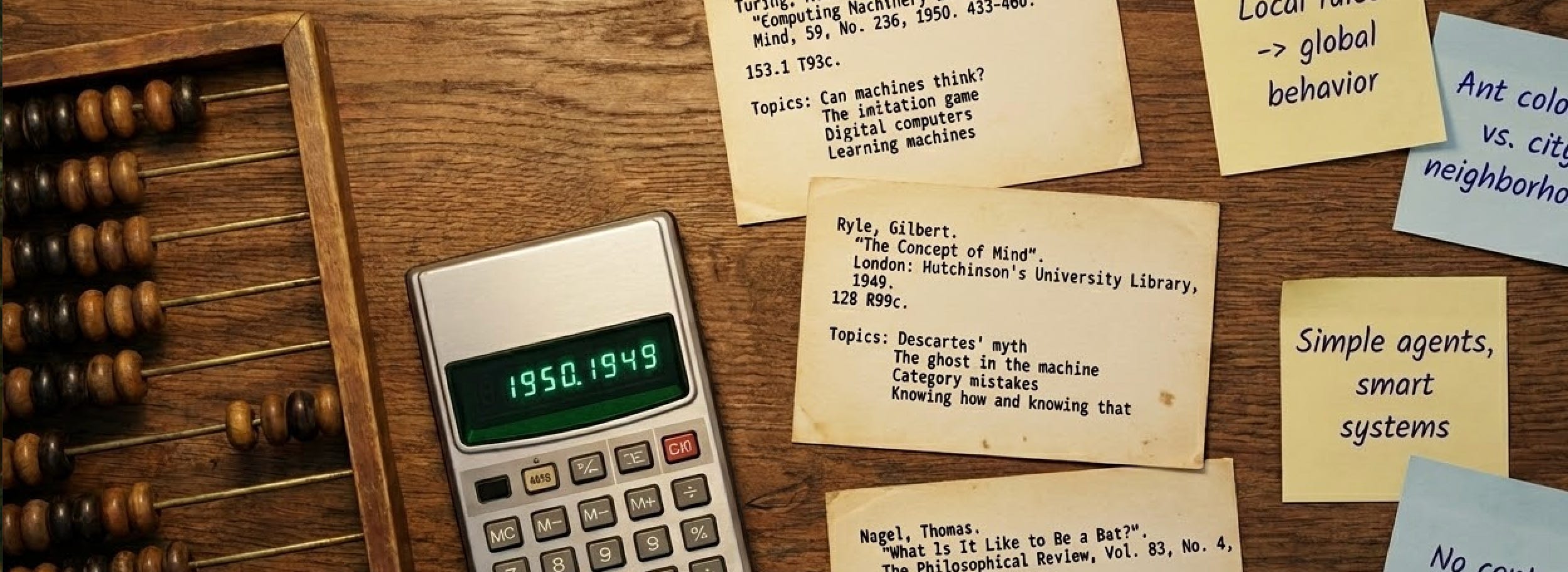
Berkeley is alluding to the phenomenon known as cognitive offloading here—a phrase first coined only a decade ago that has begun to seep into everyday conversation in the past year or so. (Its use in academia has exploded as well; Google Scholar reports 6,000 papers using the phrase in the past five years, ten times the number of references in the preceding half decade.) At first glance you might think of cognitive offloading as just academic jargon for cheating, but the concept is more subtle than that and less universally pejorative. Some forms of cognitive offloading are indeed negative in their effects, as in a student who bypasses actually researching and writing a paper by handing the task over to Claude. But other forms are clearly beneficial. There was cognitive load in navigating the complexities of index cards and the Dewey Decimal system in the old days of analog libraries; offloading that mental work to a good search algorithm actually freed up our minds to focus on more nuanced problems. Calculators undoubtedly deepened our understanding of math and economics, even though technically we were shifting our computation workloads to the machines.
The problem with the Berkeley Law approach is that it assumes that there is a fundamental zero-sum game between AI use and human thinking. The logic is: if you are using AI in any fashion, by default you are thinking less. The Berkeley ban doesn’t entertain the possibility that AI, used properly, can actually make us better thinkers. In the interest of eliminating all possible forms of cognitive offloading it also eliminates all the ways that AI can get new ideas into your brain, or push your thinking in new directions, or assess your mastery of the material you are trying to understand.
In a conversation with Dan Blumberg on the Future Around And Find Out podcast, I referred to this as cognitive uploading. The phrase came to me spontaneously in the conversation almost as a joke. (In the podcast you can hear me cycle through variations: cognitive onboarding, cognitive inputting.) But the more I’ve turned it over in my mind since then, the more I think it points to an important element of the AI education debate that has been largely ignored. For understandable reasons, we’ve spent most of our time worrying about what happens when AI does our thinking for us. But we haven’t focused enough on all the ways AI gives us new things to think about.
By cognitive uploading, I mean something more than just traditional learning, where you have pre-defined material that you know you need to understand to pass the course or do your job successfully. It should go without saying that AI can be an enormous help in achieving that kind of knowledge mastery, particularly in a source-grounded environment like NotebookLM. Think about the learning journey that is now possible using Notebook’s Quiz feature, one of our most widely used Studio artifacts, developed in partnership with the amazing LearnX team at Google: you read any document you need to understand for your class, and then dynamically generate a quiz to test your comprehension; when you get an answer wrong, you hit the “explain” button which produces a chat response walking you through why the correct answer was more appropriate than your response, with direct links back to the original passages from the source material so you can review the key elements that you misunderstood. Just a year or two ago, that kind of on-demand learning support—with bespoke assessments generated for any text dynamically—simply wasn’t an option unless you could afford a personal tutor to generate the quiz for you, evaluate your answers, and assemble a digest of key passages based on your mistakes to review. Now it’s available to anyone with a web connection.
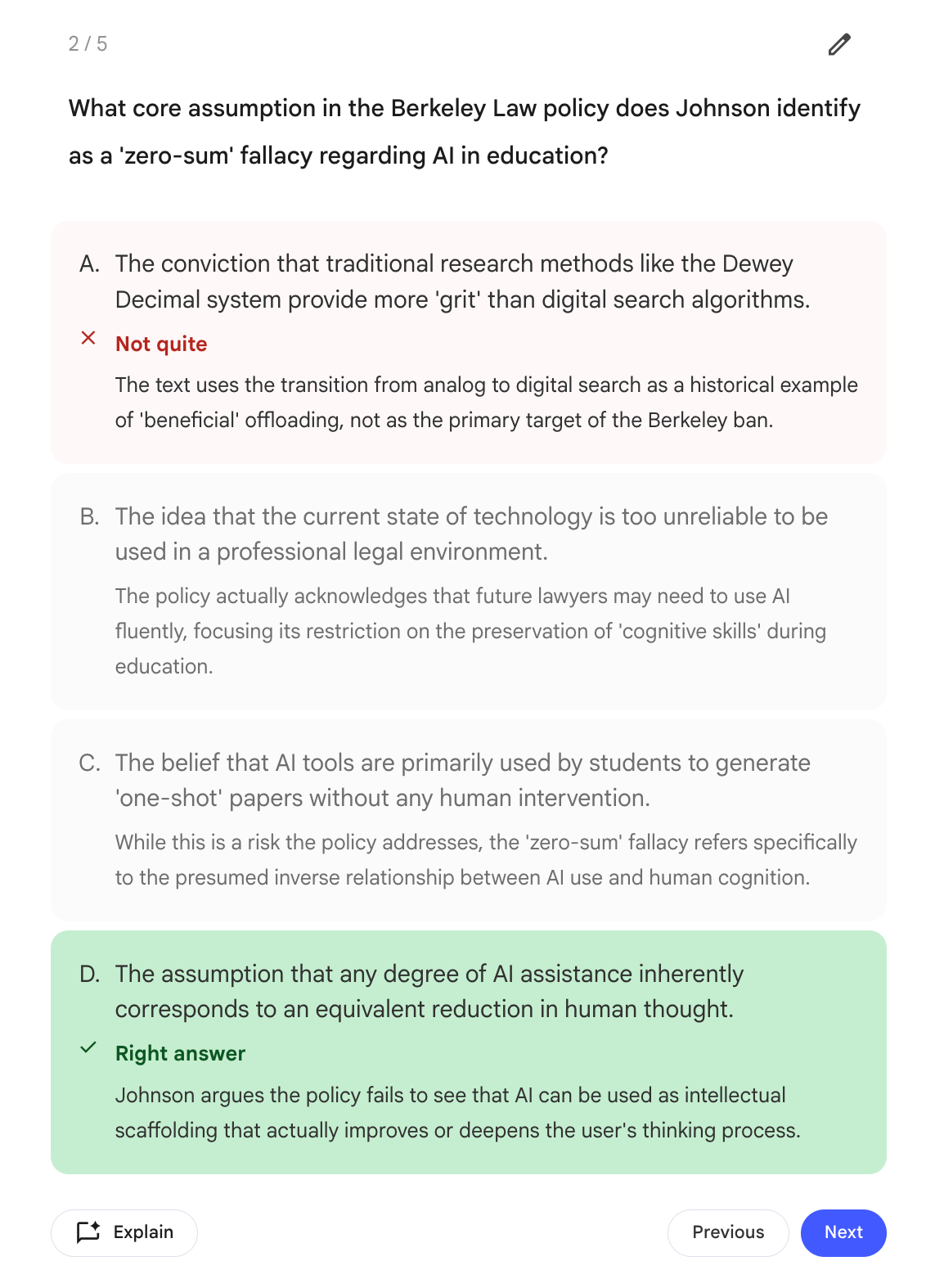
Using Quizzes in Notebook to improve your comprehension is an example of cognitive uploading where the tool helps you get “assigned information”—information you know you need to master—into your brain. But AI can just as easily steer you towards the information that you didn’t realize you needed, help you see around your own analytic blind spots, challenge your assumptions, or make novel connections that wouldn’t have otherwise occurred to you. One of my most common routines when I am working on an essay or a chapter outline is to share my latest thinking/writing with Notebook, and ask it: what am I missing? Notebook has access to all the sources I’ve used as part of the research for the project, along with my notes and other relevant things I’ve written in the past, and so it’s able to review all that material and suggest ideas or angles that hadn’t yet occurred to me, which inevitably sends me back to the original sources to explore the new lead. Or it reminds me of an earlier idea or passage that I’d forgotten about. In either case, though, the tool is giving me more to think about, not less.
Another example is using the AI as a kind of intellectual sparring partner. One of the very first prototypes we built after I joined Google was a feature we called “Contrarian.” You’d write a paragraph on any topic, and on demand the model would come up with a counter-argument to whatever you’d written. It was a bit of a party trick back in the day, and lacked any of the advanced thinking, research, and source-grounding that current AI platforms enjoy, but even then you could see the promise of it. Chatbots have a well-deserved reputation for sycophancy, but they are also skilled at adopting whatever persona you want from them. If you want the model to punch holes in your argument instead of lavishing you with praise, you can just ask for it.
AI also enables another form of cognitive uploading: triaging novel hypotheses to determine if they warrant our own deeper attention. So much of my creative thinking as a writer is a variation of hmmm.. I wonder if there’s something interesting here. By chance, I stumble across an article about ant colonies a few weeks after I’ve finished reading a book about urban development, and in my head I think: I wonder if there’s a useful connection to make between those two fields. The cost—just in time alone—of going down a rabbit hole like that has been reduced exponentially over my adult lifetime. When that ants/cities connection first occurred to me in the late 1990s, as I was gathering ideas for the book that became Emergence, it took months of ordering/reading books and visiting libraries to get enough confidence that this was an idea worth exploring. Now I can test an equivalent hypothesis—and get a high-level view of the existing thinking on the topic—in a matter of minutes using Deep Research in Notebook. It’s true that in a perfect world, the most cognitively engaged way to pursue stray hunches like this would be to assemble all the research yourself, but in practice, most of us don’t have the time for that kind of investment in an idea that is likely to be a red herring in the end. So we end up doing nothing with those hunches. The rabbit holes go unexplored. But now, by offloading the early stage exploratory research to the model, we can actually entertain more hunches and upload the most promising ones to our minds for deeper engagement.
To a certain extent, the concerns about cognitive offloading are an example of technological lag, where the mainstream discussion of AI and its impact is still framed in terms of the first-generation chatbots. The original Chat-GPT had none of the capabilities described above: source grounding, quiz generation, web research, hypothesis testing, and so on. But it was remarkably good at writing a paper for you with some clever prompting. So part of the conviction that AI is in a zero-sum battle with human thinking stems from people simply not following the progress since 2022, both in the underlying models themselves and the application frameworks we have built around them.
But I suspect the primary reason why we are so quick to resort to outright bans is we don’t have a clear enough picture in our heads yet of what an ideal engagement with AI would look like. What’s the partnership that helps you master the material but also make new connections? For understandable reasons, the conversation has mostly focused on the students who are tempted to use AI to bypass the hard work of thinking and learning, who simply want to create the illusion of understanding the material in order to pass the course and get on with their lives. But what about the students who genuinely want to deepen their understanding? How might AI actually assist them in that journey?
As a thought experiment, I tried to imagine what the optimal approach would be for writing an intensive research paper, assuming a student that honestly wants to maximize their understanding and create a compelling and original paper that will demonstrate their command of the material. It would look something like this:
You read the assignment. In partnership with the AI, you make a plan to establish which primary sources you need to read to be able to write an accurate and original paper, and which sources you’ll need to consult but not read in their entirety. “Directed research”—where you dispatch an agent to find sources based on a prompt you write—is encouraged. (Find me the most relevant primary texts and secondary commentary that I need to understand the Watergate break-in.) That’s good cognitive offloading. And knowing how to prompt a complex research query is a valuable skill to master, at least for the 2026 rendition of the job market.
You then read all of the essential sources, highlighting and annotating as you do. You can query the AI to help you understand specific passages or larger questions, but you don’t skip the crucial step of actually reading the material. The AI can draw on the supplemental sources (even if you haven’t read them) when answering your questions; on occasion, the AI will suggest highly relevant sections from the secondary material which you read and annotate as well.
Once you’ve completed the primary reading, you decide on the overall approach and draft an outline, with the AI assistant providing feedback where needed. You can ask “negative search space” questions like: what am I missing? What’s the thing that I need to know to write this essay that I don’t know about yet?
And then you sit down to write the paper. You draft everything yourself but consult with AI throughout: fact-checking based on the assembled sources, asking for stylistic alternative phrasing, chasing down surprising new leads as they emerge in the writing.
The rule of thumb is effectively to imagine that you have a professional-grade researcher, tutor, and editor at your side and just treat the AI the way you would treat those human collaborators. You wouldn’t ask your tutor to do your homework for you, but you would happily ask them to explain the cosmological constant or test your knowledge of the Dred Scott decision. I’ve been lucky enough to work with some brilliant editors over the course of my career. Do I lean on them to help me tighten or expand the outline for an essay I am writing? Do I ask them for alternate approaches to a particularly tricky section transition? Of course. (Is that cognitive offloading? No—it’s giving me more material to work with, expanding my sense of what’s possible.) But I would never ask my editor to write the whole essay for me. The same common sense principles should apply to working with AI.
I truly believe that following this kind of approach to AI in the classroom would, in the aggregate, produce better learning outcomes than the research and writing workflows available to students pre-AI. It would strengthen the students’ cognitive skills, not cause them to atrophy. I even suspect some of the faculty at Berkeley Law might embrace this approach if they felt it was a valid option. The harder question, though, is how you encourage or even enforce that kind of usage.
I could see a case for the Berkeley ban based entirely on the practical realities: today’s AI platforms could be terrific tools for thought, helping students deepen their understanding, but in reality, most students are going to take the low road and just one-shot their essay if you open the door for AI use even slightly. In other words, in theory AI is capable of providing brilliant intellectual scaffolding, but in practice, gravity always wins out in the end. I think that’s probably too cynical, or at least we’re too early in the development of these tools to make that call. So often with new software paradigms, what looks like inevitability turns out to be just design failure that can be solved with the right guardrails or affordances or system instructions. But I also think it is incumbent on those of us who are building these new platforms to figure out how to steer learners towards the deeper path, and away from the siren song of the one-shot paper. Certainly this is a project that we are deeply engaged with at NotebookLM. (Our original slogan for the product was “Do Your Best Thinking”—not “Let Us Do Your Thinking For You.”) But to move past this phase of outright bans, we’re going to need to build a new consensus—from educators and students alike—that a good-faith partnership with AI doesn’t just offer an escape route from cognition, but can actually make us better at the productive struggle of thinking.
Here’s the full conversation with Dan Blumberg:
And in other podcast news, I had a wonderful chat with Radical Candor author Kim Scott about my last book, The Infernal Machine:
A fascinating piece by Steven Johnson. I am a senior (89) who takes an occipital course at NC State University's OLLI (Osher Lifelong Learning Institute). They are devoting a major part of this next semester to AI. I wish Steven could lecture there on AI and Notebook LM.
Full disclosure. Steven is my nephew and my son's best friend. They attended high school (St Albans) and college (Brown) together. I learn from them every day. Nothing artificial about this.
Lewis Mumford argued that the difference between a machine and a tool is that the machine dictates when and how it should be used, whereas a tool lets the user decide.
AI is here to stay, the question is whether we will become cogs in a machine or master it as a craftsperson masters their tools. This is one of the most practical essays I've read on how to do that, with a clear example in the context of research and writing. Thanks!