


Earlier this year, I shared a public notebook that I’d created called The Architecture Of Ideas, which assembled a collection of Substack and Medium articles I’d written over the past decade or so on the themes of creativity and innovation. The goal was to gather together all the knowledge that I had released publicly on those topics so that you, dear reader, could actually engage in a conversation with that body of work, and have all that expertise on tap to give you advice on whatever project you happened to be working on. You could, if you wanted, describe your current workflow and ask for advice about how to better optimize it for creative time, or get specific feedback on your approach to the book you are thinking of writing. You could read the original articles, of course—that’s the beauty of Gemini Notebook’s source panel—but more importantly, you could use AI to apply the knowledge contained in those articles to your own unique situation.
But there was an obvious missing piece in that notebook—three missing pieces actually. Between 2010 and 2016 I’d written a trilogy of books on the patterns and practices behind history’s most important innovations: Where Good Ideas Come From, How We Got To Now, and Wonderland. When you added up all the Substack and Medium posts I’d curated for the Architecture Of Ideas notebook, they came to about thirty thousand words in total, the length of a single novella. But I had something like another quarter million words on the history of innovation—words that I’d spent years researching, that had been carefully edited and fact-checked—that would have radically improved and expanded the knowledge base in that notebook.
The problem was that I had no legitimate way to share that knowledge via the Notebook platform. These are all books that are still very much in print and not yet in the public domain; even if I’d wanted to just give away the entire text of them for free, my publishers and agents might have had a word to say about that. I could have added a sample chapter from each book, I suppose, or generated a summary—but if I was going to share my expertise in the notebook, I didn’t want it to be an abridged version; I wanted to be able to share the final product that I had spent years researching, crafting, and polishing. Those books represent the best of my thinking on innovation—in part because they took so much time, and drew on the expertise of so many amazing collaborators—but if I wanted to publish them in the notebook, my only option was to give them away.
This was a limitation that went far beyond my personal predicament. We built Notebook around a simple promise: the AI would anchor every answer in the exact documents you selected—a medical study, interview transcripts, market research. We wanted Notebook to be a guide to the human-authored knowledge that you curated for your project, not an oracle. And so we designed Notebook so that you could read the original source materials, and ensured that every AI answer came with citations that took you back to the exact passages from the original text that the model used to answer your questions. That source-grounding approach has been a major reason why Notebook ended up being so enthusiastically received by students, scholars, and other knowledge workers over the past few years. Defining your own knowledge base or “context” helps you personalize the assistance that AI provides you; it creates more trust and reduces hallucination; and it avoids the pitfalls of overly-predictable AI slop. (The broader philosophy behind this is covered in depth in an essay I wrote a few years ago called You Exist In The Long Context.) But even as the techniques of source-grounding that we had pioneered at Notebook were adopted by other AI platforms, there was always a kind of intellectual dark matter at the center of all that work. The world’s most valuable context—the knowledge so useful that people were willing to pay money for it—was trapped behind paywalls of one sort or another: in books, newspapers and magazines that required subscriptions, academic publications, premium research databases. Even if you’d purchased a book, there was no direct way to bring the complete text into Notebook to explore the ideas using all the new tools for understanding that the platform had introduced. We built state-of-the-art research agents into Notebook and Gemini, but the agents were unable to retrieve articles for you from paywalled publications—even if you were a paying subscriber or had institutional access to the archives.
Even in the early days of Notebook, we talked about a future version of the product where all that intellectual dark matter could be made accessible—and not just for the benefit of our users, but also for the benefit of authors and publishers themselves, or anyone with valuable expertise to sell. (We called them “knowledge bottles” back then!) We talked about a future where users could pay to build a brain trust of experts to debate potential solutions to a challenging problem, using the AI to synthesize insights drawn from multiple published sources. Non-fiction advice—a genre that has been struggling lately in bookstores—seemed particularly ripe for reinvention in the age of source-grounded AI.
I knew as an author that all those emerging possibilities would introduce new freedoms for my readers: the freedom to ask questions back to my books, or remix them into other formats. But it was clear for this to work in practice, we would need to introduce a new set of restrictions as well: involving training, sharing, attribution, and most of all ensuring that authors and publishers were compensated for their work. And so for the past year or so, a small team of us at Google has been in deep conversation with authors, publishers, educators, and other guardians of expert knowledge, trying to settle on a framework that maximized the opportunities for new AI-first applications, while protecting the interests of—and generating new revenue possibilities for—knowledge creators of all stripes.
All those conversations culminated in an announcement last month introducing what will ultimately be a cross-Google framework, launching first at Gemini Notebook but coming soon to Gemini, Search, and more. We call it Expert Intelligence.
To keep things simple, the initial incarnation of Expert Intelligence is built around the existing framework of ebooks. Working with a long list of top publishers, including Penguin Random House, Bloomsbury, Harper Collins and more, we’ve made more than 100,000 books from the Google Play bookstore available to use as sources inside of Notebook. You buy the book, and you can add it to any notebook in exactly the way you add normal sources like Docs or PDFs. (You can also read it with all the standard e-book reader features in the Play Books app, though we hope to bring more of those reading experiences to Notebook over time.) Inside of Notebook you can ask questions based on the book content, and get grounded answers with citations back to the original passages; you can combine different books to create a diverse brain trust inside a single notebook if you want a “team of rivals” approach; and of course you can generate artifacts like quizzes or audio overviews to deepen your understanding of the material, or explore its applications to your own work.
We’ve also partnered with our friends at Next Big Idea to curate a collection of Featured Notebooks produced by an all-star list of nonfiction authors, where each book is accompanied by supplementary sources (further reading, interviews with the authors) along with author-created artifacts to help you navigate their ideas. You can engage with the author’s work in the Featured Notebook, but if you purchase the book, you can also add it to any notebook you want. The launch lineup includes notebooks built around Eric Ries’ The Lean Startup, Mary Claire Haver’s The New Menopause, Dan Pink’s When, Derek Thompson’s Hit Makers, Annie Duke’s Thinking In Bets, and Kim Scott’s Radical Candor. (For US-based readers, we’re also running a limited time promotion where Google will buy one of these books for you so you can try out the whole experience.) We’ll continue expanding both the Featured Notebook titles and the overall catalog available.
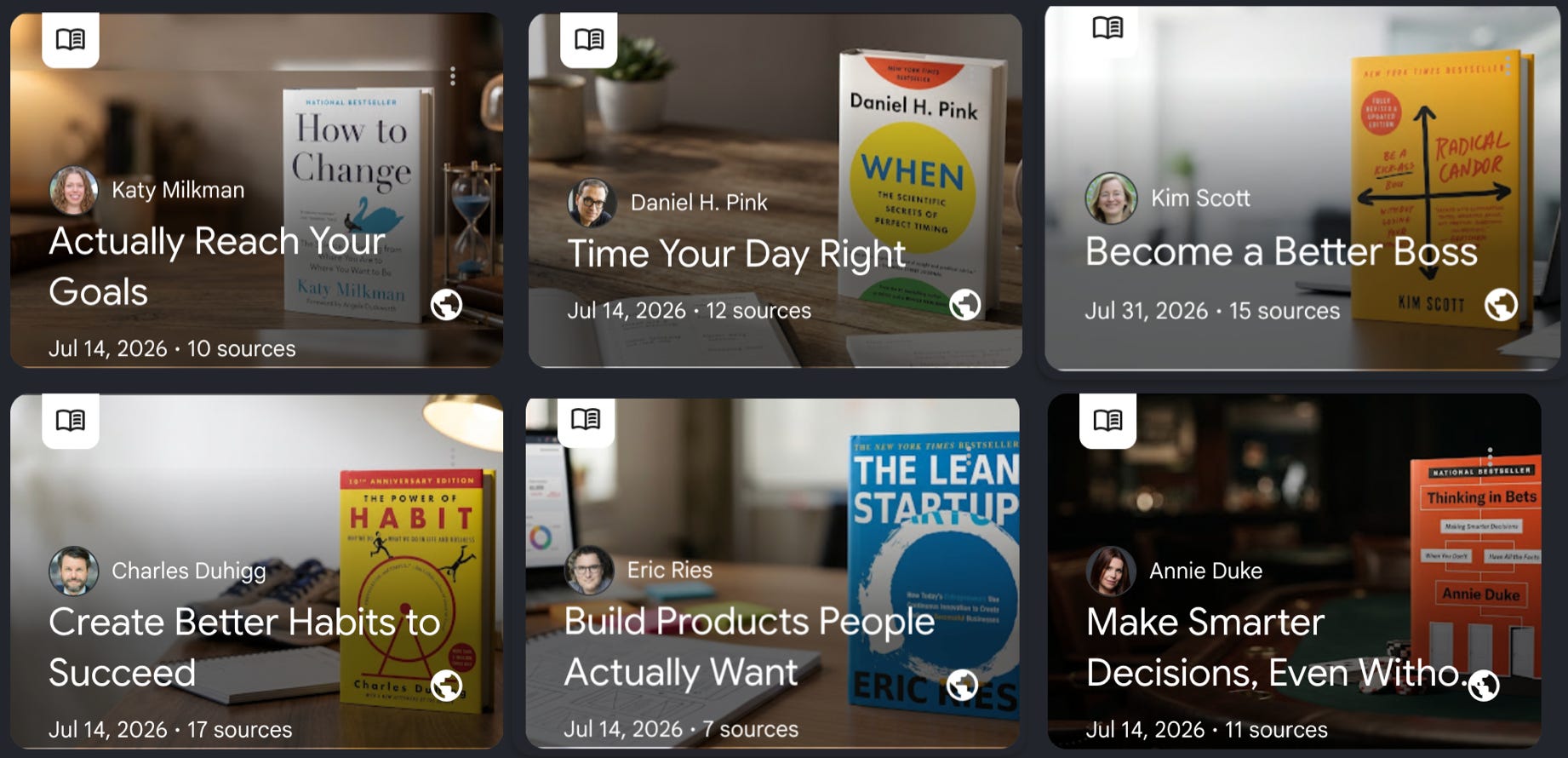
One of the great things about Expert Intelligence is that it gives you the confidence to know that you are using AI to engage with the intellectual property of your favorite authors in a way that those authors have explicitly endorsed. We’ve built in limitations throughout the framework to ensure that the interests of creators and publishers are respected. The most obvious one involves sharing: you can indeed share a notebook that contains an EI source—we suspect this will be a terrific format for classroom or book club sharing, for instance—but the recipient of that notebook cannot interact with the content in the protected source until they purchase it.
While the original text of books is protected, readers will be allowed to share the transformative artifacts they create from it: audio overviews, quizzes, slide decks, etc. (Or at least most of them; there will be some limits on artifacts that are summaries of individual works.) We view these artifacts as powerful promotional tools—much like human-hosted podcasts drive book sales today—that extend the reach of an author’s ideas without exposing the source text itself. But we’ve altered the way Notebook works so that every artifact generated from the book will include clear attribution and a direct link to purchase the book. (For those of you who know the history, there’s an element of Ted Nelson’s visionary Xanadu project in how we designed the attribution system.)
As an author, it was crucial to me that we did the work to get those protections in the right place, and so it’s been especially rewarding to see the reception from the publishing industry after the launch last month. This article in Publisher’s Weekly gives you the best sense of it, I think:
“In something of a first, Google has launched a new AI application for books that publishers seem to actually like, thanks to its apparent respect for copyright protections…. Nihar Malaviya, CEO of PRH, said in a statement that EI “is an example of how AI use cases can be developed responsibly.” He commended Google’s commitment to building copyright protections and transparent attribution into the experience.
“Requiring readers to purchase a book before they can use Gemini Notebook’s AI features to engage with that work recognizes the value of books while putting meaningful guardrails around how copyrighted content is used,” Malaviya said.
Authors Guild CEO Mary Rasenberger agreed with Malaviya that EI “is a positive step forward in the legitimized use of books in the AI ecosystem to the benefit of readers, publishers and authors alike.”
She added that without knowing the details of the deals between Google and publishers, she is nevertheless hopeful that “these kinds of arrangements should open up new audiences for books,” allowing for ongoing interaction between readers and the books they love “while ensuring authors and publishers retain control.”
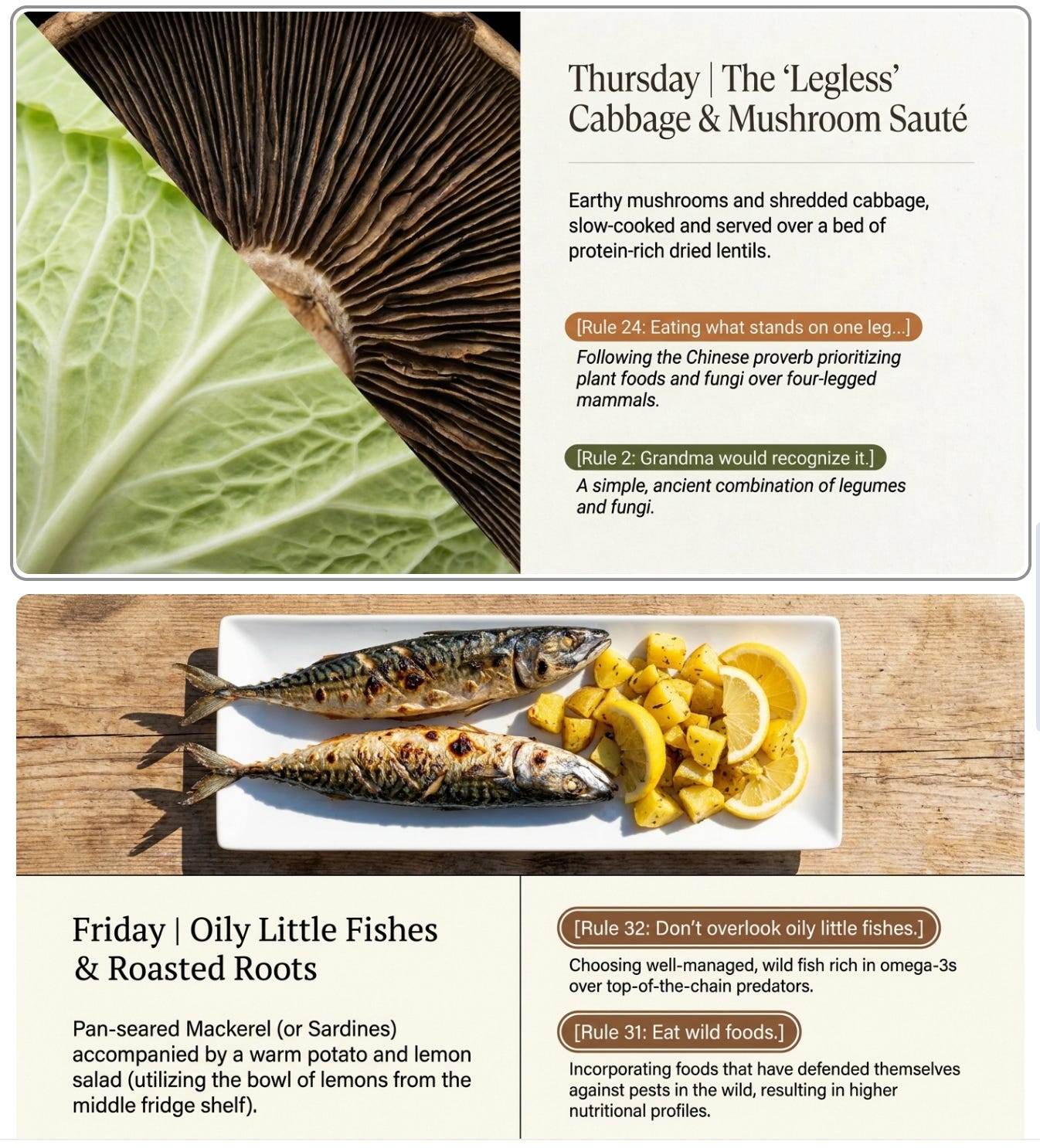
Let me give you two quick examples of how I am using Expert Intelligence as a consumer. One of our Featured Notebooks is based on Michael Pollan’s book Food Rules, which is particularly well suited for AI because the whole book is effectively structured around a series of system instructions for eating better—all based on Pollan’s research and writing on food dating back to his classic Omnivore’s Dilemma. If you purchase Food Rules, and either make a copy of his Featured Notebook, or just add the book as a source to a new notebook, you can literally upload a photo of your fridge and ask for a detailed meal plan based on Pollan’s philosophy, drawn from the ingredients in your kitchen. Slide Decks are particularly well suited for this kind of exercise — it’s like you’re generating a custom cookbook each week, with Michael Pollan as your culinary advisor:
Another book in our launch lineup is The Sense Of Style, Steven Pinker’s wonderful 2014 treatise on writing. I now make it a practice to add the book to every notebook where I am working on some kind of writing project. When I finish a section, or a first draft of a shorter piece, I ask Notebook to give me a critique and line edit from Pinker’s point of view. The standard prompt I use is: “Take a look at what I’ve written so far and give me a detailed critique with specific suggestions to improve my prose based on Pinker’s approach. Explain how each change reflects his underlying philosophy of good writing.” Here’s an excerpt of feedback I received for the first draft of this piece:
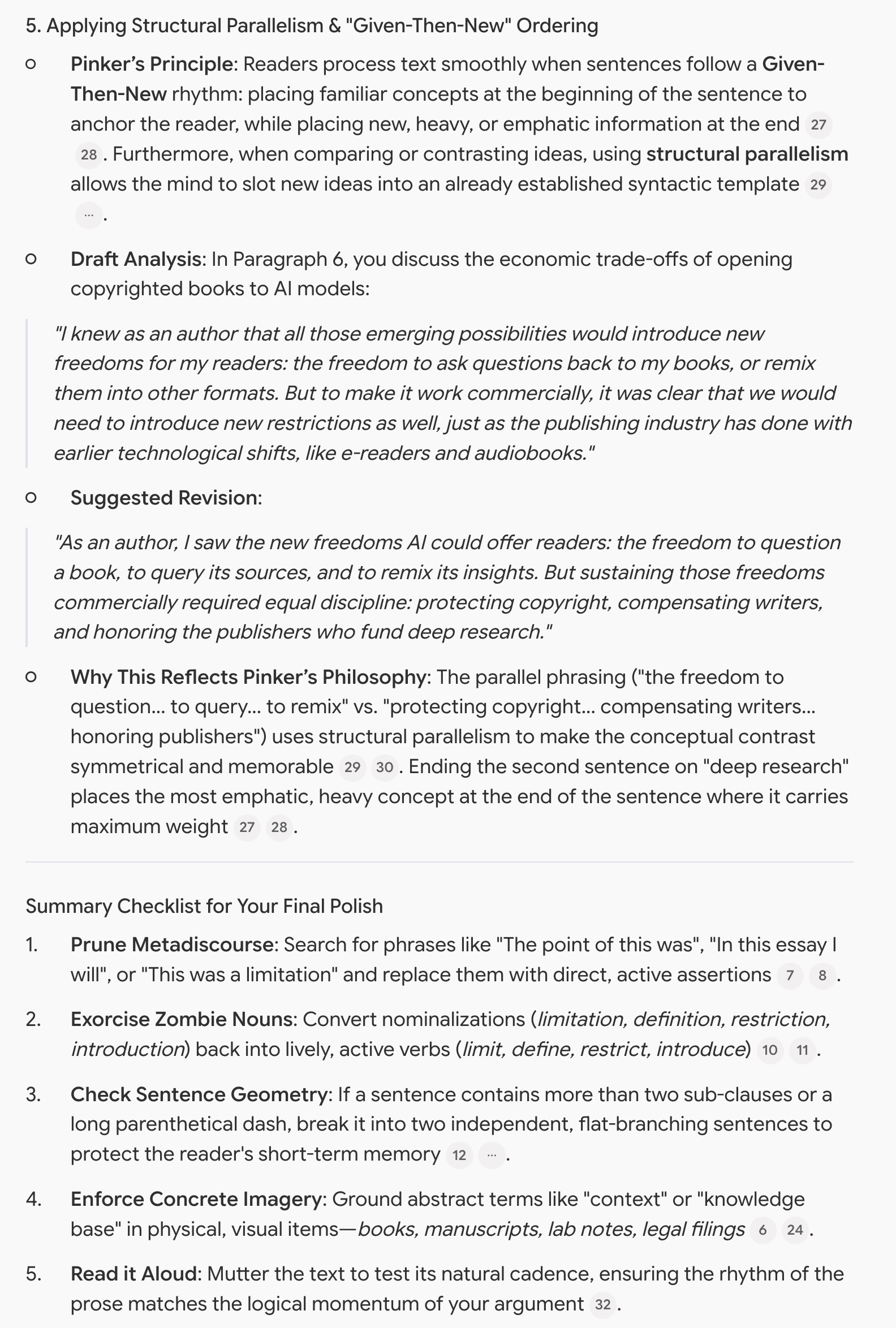
This is a terrific example of a larger point that I hope to write about in more depth later: the much maligned problem of “AI slop” can be easily solved with the right source grounding. What you see in this exchange is not the average of all writing advice on the internet, the most “predictable” tokens; instead it’s sharp, opinionated criticism, anchored in the wisdom of a specific domain expert. I don’t always follow Pinker’s advice in these edit sessions—I’m an opinionated domain expert when it comes to writing myself!—but I always find at least a few improvements that I end up integrating into my drafts, and even when I decline his advice, I find it helpful to think through why exactly I am breaking from those stylistic conventions. And because Notebook takes the added step of explaining how the suggested edit relates to Pinker’s philosophy—and because all of its interventions include citations back to the most relevant passages—I don’t just feel like I’m improving my prose; I’m also learning general principles that I’ll be able to apply myself, the next time I find myself using zombie nouns or contemplating a “given-then-new” structure.
The integration with Play Books is only the beginning of the Expert Intelligence program. Now that we have a framework that allows paywalled content to work inside Google’s AI platforms, there’s a whole world of opportunity to explore here. Some of it may look like existing marketplaces: allowing research agents to explore the archives of publications you already subscribe to, or bringing textbooks that schools have purchased into student notebooks. But we think there will be entirely new ways for users to draw on human expertise as the program expands, which will create new opportunities for authors and publishers to profit from their work. In the meantime, I have updated the Architecture Of Ideas notebook with the innovation trilogy of Where Good Ideas Come From, How We Got To Now, and Wonderland—and also included an anthology of classic essays and interviews I edited called The Innovator’s Cookbook. If you’ve been inspired by my writing on innovation over the years, you might want to try adding some or all of those works as an on-demand brain trust for your own projects. For those of you who already purchased those books on other platforms—or in print—for the time being you’ll need to purchase them again through Play Books to get the full experience. (Perhaps some day that will change, but not for a while.) I’ve also included an overview of all the launch Featured Notebooks below, with links to both the US/Canada and UK/international version. The books are only in English for the time being, though we are actively working on integrating new languages given how international Notebook’s user base is.
As always, I’d love to hear what you find most helpful—and of course do send along suggestions from your own personal canon of great books that you’d like to see included in the program.
Here’s the full list of launch Featured Notebooks:
Eat Smarter, Live Better, based on Michael Pollan’s Food Rules. (International edition.)
Decode Why Things Catch On, based on Derek Thompson’s Hit Makers: The Science of Popularity. (International edition.)
Actually Reach Your Goals, based on Katy Milkman’s How to Change: The Science of Getting from Where You Are to Where You Want to Be. (International edition.)
Become a Better Boss, based on Kim Scott’s Radical Candor: Be a Kick-Ass Boss Without Losing Your Humanity. (International edition.)
Build a High-Performing Culture, based on Daniel Coyle’s The Culture Code: The Secrets of Highly Successful Groups. (International edition.)
Build Products People Actually Want, based on Eric Ries’s The Lean Startup: How Today’s Entrepreneurs Use Continuous Innovation to Create Radically Successful Businesses. (International edition.)
Navigate menopause with confidence, based on Mary Claire Haver’s The New Menopause: Navigating Your Path Through Hormonal Change with Purpose, Power, and Facts. (International edition.)
Create better habits to succeed, based on Charles Duhigg’s The Power of Habit: Why We Do What We Do in Life and Business. (International edition.)
Improve your prose style, based on Steven Pinker’s The Sense of Style. (International edition.)
Time Your Day Right, based on Daniel Pink’s When: The Scientific Secrets of Perfect Timing. (International edition.)
Raise Kids Who Thrive, based on Jennifer Wallace’s Never Enough.
Make Smarter Decisions, Even Without All the Facts, based on Annie Duke’s Thinking in Bets: Making Smarter Decisions When You Don’t Have All the Facts.
Learn why range beats early specialization, based on David Epstein’s Range. (International edition.)
How Nvidia Powered the AI Revolution, based on Stephen Witt’s The Thinking Machine. (International edition.)
Thanks for the comments all! As much as I love my new partners at Play Books, I will confess among us friends that I too have almost a thousand Kindle books that I have purchased over the years. So I share your interest in figuring out a way to make that catalog work with EI. (Sadly, I don't see a clear path with print books, as much as I would love one as well.) But in the meantime, a couple of thoughts:
1. Thus far, we only have a small fraction of the big publisher's book catalogs available for EI, so even if we suddenly added support for Kindle, most of your personal collections would not work. Our goal longterm is to get every book in print part of EI by default, but there's a lot of AI anxiety out there, so this is going to take some time.
2. It is very easy, however, to bring your highlights (ie, selected text) from Kindle books over to Notebook -- ReadWise has an excellent Kindle-to-Docs converter that is optimized for Notebook so you can at least have your most inspirational quotes from your Kindle collection available to you in Notebook.
I second Gerd’s comment but want to add the thousand or more books on dead trees that I have in my home library (including many of yours). I have been using Notebook for a number of years now and it has proven invaluable but this limitation continues to hobble me. This requires a more systemic approach than simply buying books yet again (they were expensive enough the first time). I wrote about this almost two years ago. It’s posted here: https://ideaspaces.net/unshacklinginnovation/ Copyright is a central contradiction that we’re going to need to revisit in an AI context.