
The Wetlands Interregnum
In part two of Planet of the Barbarians: how Cold War espionage gave us new insight into the origins of the agricultural revolution.

Brief recap of the previous post: In part one, I explored two “standard narratives” of the Agricultural Revolution upended by new research. First, the view popularized by Yuval Noah Harari and Jared Diamond, which frames the transition as a multi-millennium-long mistake leading to harder labor and social hierarchy; and second, Karl Wittfogel’s theory that the state emerged to manage the irrigation of an arid Mesopotamian landscape.
Shortly after Karl Wittfogel published Oriental Despotism, the United States began secretly flying its Corona satellites over the Middle East to survey the Soviet Union’s interests in the region. Launched just two years after Sputnik, with the primary objective of spying on territory inside the USSR, the Corona program featured some brilliant technological hacks to transmit high-resolution imagery back to the ground. Remember this was seventy years before Starlink, fifty years before Google Earth; even digital photography was still a decade away. If you wanted to take a detailed photograph from space you had to shoot it on film—and you had to somehow retrieve those physical canisters of film from a satellite that had been permanently consigned to low-earth orbit.
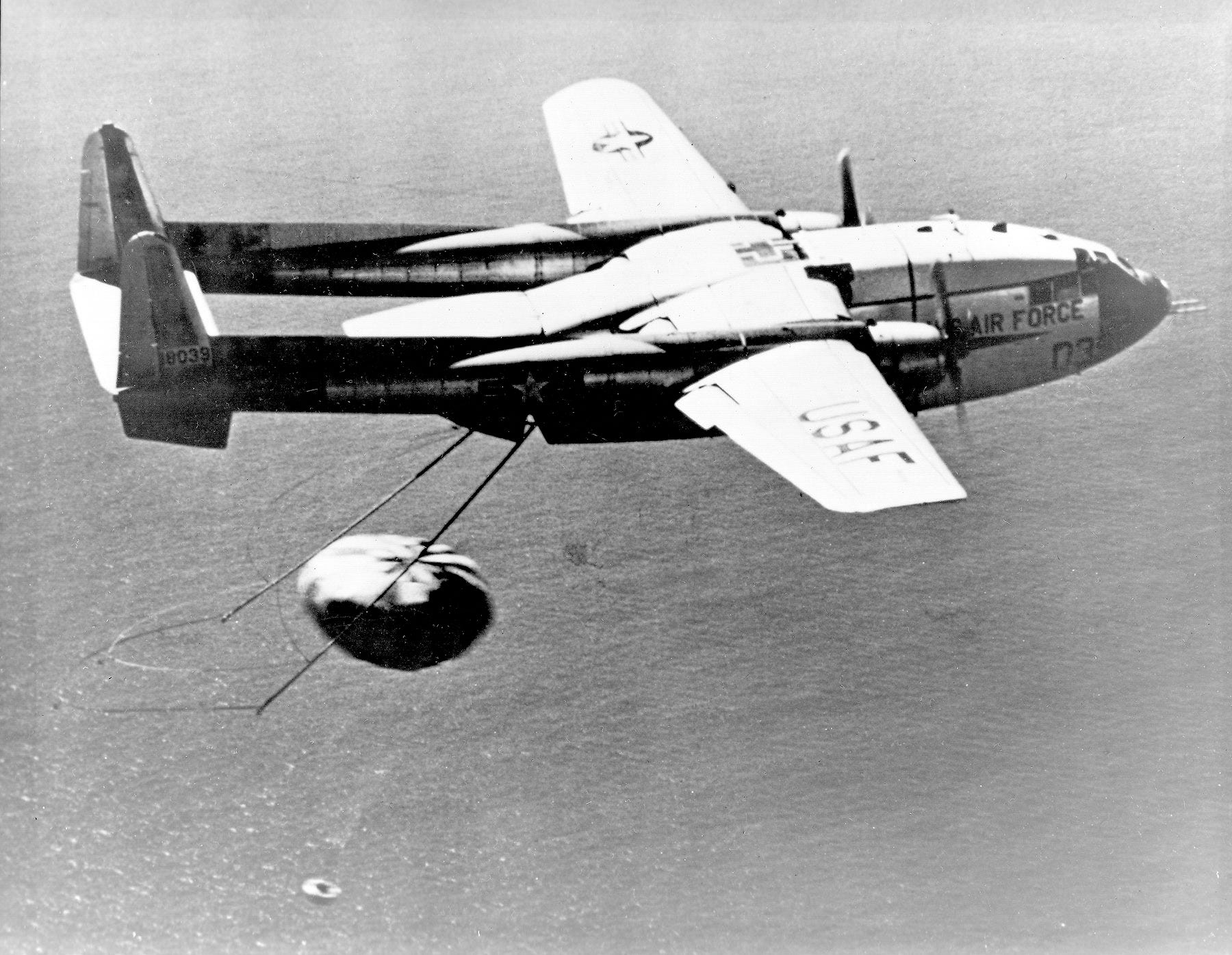
To get around those limitations, the CIA, in partnership with the Air Force, devised an ingenious system that produced a genuinely new way of seeing the earth’s surface. The Corona program’s method for data transmission involved high-stakes mid-air acrobatics. Since digital transmission was impossible, the satellite had to physically eject its “film bucket”—a specialized recovery capsule—into the atmosphere. As the capsule plummeted toward Earth, it would deploy a parachute to slow its descent. A specialized Air Force C-119—known aptly as the “Flying Boxcar”—would then snag the parachute out of the sky using a giant grappling hook.
The technology inside the satellite was equally sophisticated. By the late 1960s, the KH-4 systems, as they were called, carried dual panoramic cameras—one facing forward and one backward—to provide a stereoscopic view of the terrain. This was an essential perceptual leap; by capturing the same location from two different angles, analysts could construct a 3D topographic model of the landscape. While early iterations had a resolution of about 25 feet, the later KH-4B models could resolve details as small as six feet.
The imagery generated by Corona gave the spies back at Langley a view that Wittfogel and his contemporaries could only dream of. The archeologists of the 50s and 60s were, in a sense, the victims of the Street View vantage point they were still restricted to; they could barely imagine the perspective that a stereoscopic Google Earth-like view could provide. They were looking at the parched, cracked earth at ground level, and projecting that aridity back six millennia, assuming the landscape had always been a desert in need of civil engineers. They saw the ruins of ancient canals and assumed that the state had constructed them out of necessity to build an artificial oasis in an otherwise desiccated landscape.
Presumably the CIA learned very little about the activities of the red menace from their flyovers of the Iraqi desert. But whatever knowledge they were able to extract from those 3D images remained limited to a few hundred analysts with top-security clearances. The Berlin wall fell, the cold war dissipated, but the images themselves stayed classified.
And then Al Gore got interested in the Corona data. As a senator in the early 90s, Gore began lobbying the intelligence community to repurpose their Cold War assets now that the Soviet threat had collapsed. Gore’s argument was that the CIA was sitting on the world’s most pristine baseline data for planetary health—a record of ecosystems captured before the most intensive decades of industrial degradation.
Gore’s ascension to the Vice Presidency in 1993 gave him newfound persuasive powers with the intelligence community, culminating in Executive Order 12951. Signed by Bill Clinton in February 1995, the order declassified more than 800,000 images collected between 1960 and 1972, directing the transfer of film canisters from the CIA to the National Archives and the U.S. Geological Survey (USGS). This migration was a massive physical undertaking: a handoff of miles of master film that had been sequestered in intelligence vaults for decades. It took eighteen months to execute, but by the late 1990s, the film reached the public USGS EROS Data Center in South Dakota.
For three decades the information in those satellite images had been restricted to the intelligence community, scrutinized for troop movements and missile silos and uranium enrichment sites.
But now it belonged to science.
Keep reading with a 7-day free trial
Subscribe to Adjacent Possible to keep reading this post and get 7 days of free access to the full post archives.